
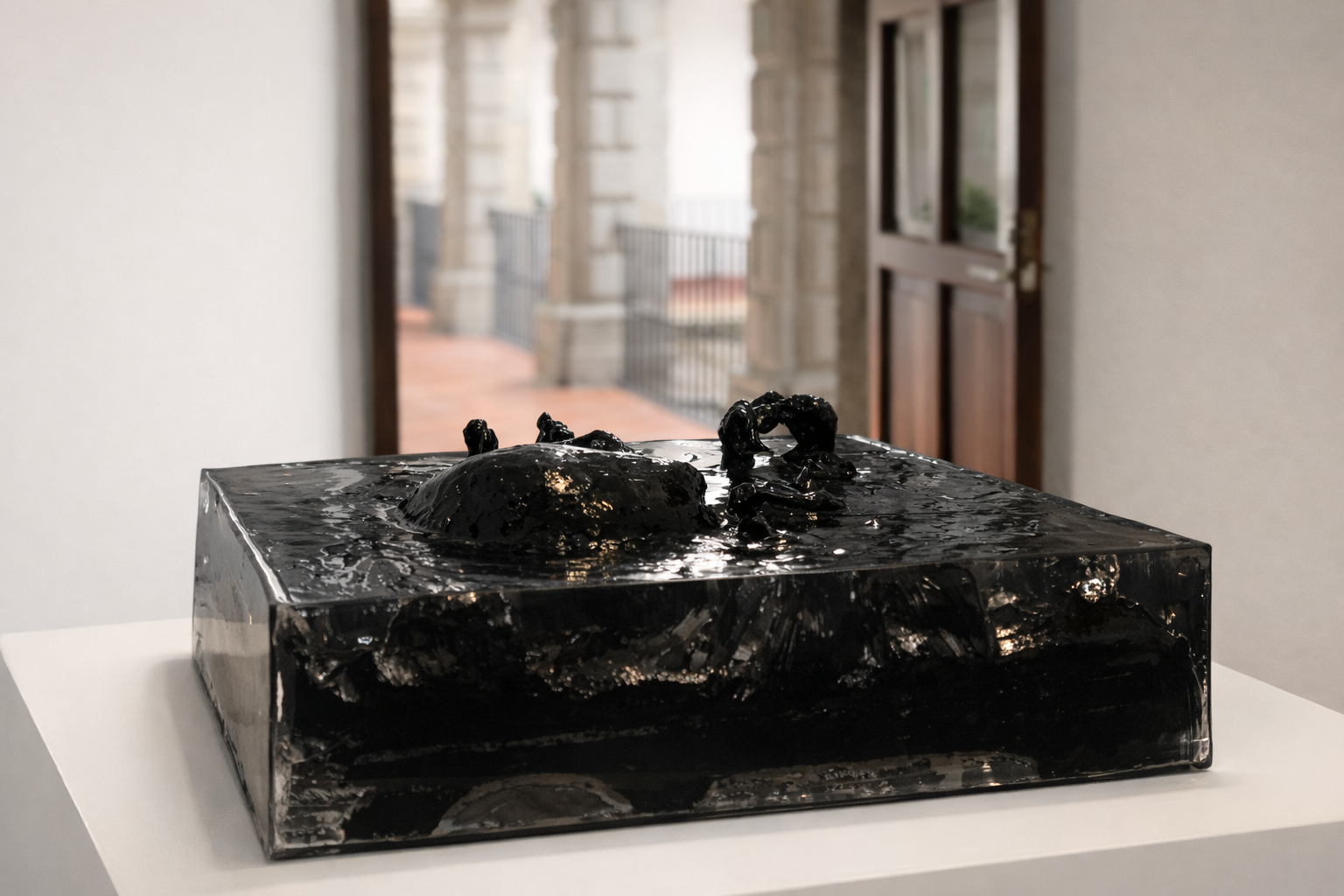
Mexican Skull: Identity and Memory — Reflections at the Close of the Exhibition at the Museo de la Cancillería
7 de July de 2026
By Perla Arroyo
Calavera Mexicana® · July 2026
There is a figure that runs through the entire cultural history of Mexico without fully belonging to any single period: the skull. It is not a symbol of Day of the Dead, though it lives there too. It is not a pre-Hispanic relic, though it is rooted there as well. It is, rather, an image that persists because it has not yet finished being explained. And that persistence, I believe, is the most honest signal that something within it remains alive — and the starting point for Mexican contemporary art that takes seriously the question of what it means to produce from here.
The exhibition Mexican Skull: Identity and Memory, presented at the Museo de la Cancillería from April 30 to June 26, 2026, began from that observation — not from an answer, but from a question I have spent years trying to formulate precisely: how is an image of identity constructed in a context where different traditions continue to operate simultaneously, without fully integrating?
Two Traditions That Do Not Merge
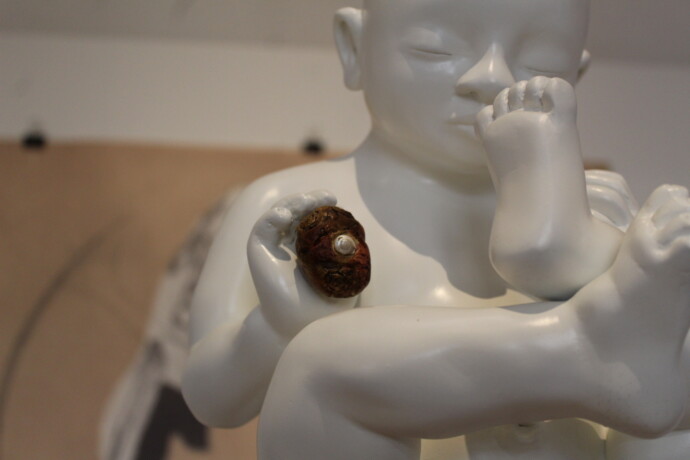
The exhibition proposed a crossing between two cultural matrices that have deeply shaped the history of Mexico: on one hand, the Western Christian tradition, with its linear conception of time and its narratives of sacrifice as redemption or punishment; on the other, Mesoamerican worldviews, in which life, death, and equilibrium are part of a cyclical logic where nothing is lost and everything transforms.
That tension was the conceptual axis of the exhibition, articulated in a timeline I developed for the wall text: ‘Two Traditions in Tension.’ Rather than fully merging, these traditions coexist and come into conflict. Death may appear as ritual and symbol, but also as loss and injustice. Childhood, in turn, takes on different meanings depending on the cultural framework through which it is understood.
The most revealing point of tension between these two traditions is not the skull itself, but what each tradition does with the death of the innocent.
In the Judeo-Christian tradition, the death of the Holy Innocents — narrated in the Gospel of Matthew (2:16) — represents the violation of innocence by power: Herod orders the killing of all male children under two years of age in Bethlehem. It is a death as injustice. As tragedy. As irreparable loss. The narrative does not seek equilibrium; it seeks mourning, the memory of the wrong, and the promise of future redemption.
In Mesoamerican contexts, ritual child death — archaeologically documented in Teotihuacan from the Classic period onward, with findings of infant burials in ceremonial spaces linked to the Pyramid of the Sun — does not carry the same semantic framework. It is not punishment, nor tragedy in the Western sense. It is offering. Participation in the cosmic cycle. In Nahuatl logic, a form of equilibrium: returning to the cosmos what the cosmos has given, so that the cosmos may continue to give.
These two readings do not only contradict each other theologically. They contradict each other in what they propose as the relationship between the human being and death: one holds that the death of the innocent must be mourned and remembered as injustice; the other, that it may be consecrated as participation in a greater order.
What interests me is not resolving which of the two is correct. What interests me is that both continue to operate, simultaneously, within the Mexican cultural imagination. And that this simultaneous operation is precisely what makes Mexican cultural identity not a coherent unity, but a process in permanent tension.
The Skull as Archive
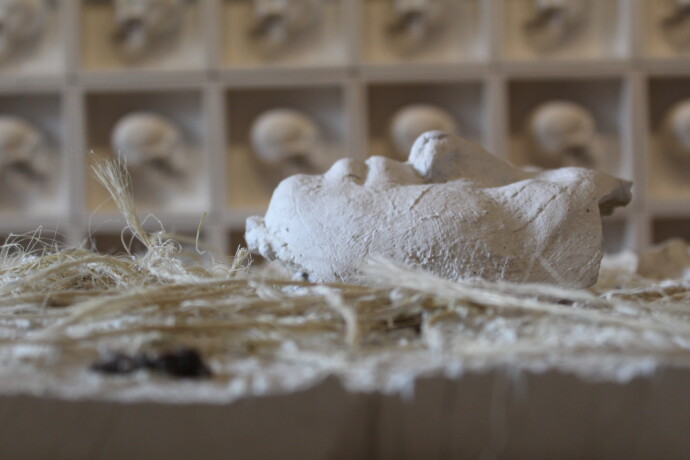
The exhibition’s wall text proposed reading the skull as a vessel of meaning: a structure inscribed with visual inheritances, historical tensions, and different ways of understanding life and death. A resilient form layered with meaning, where past and present become intertwined.
That reading is not metaphorical. It is literal.
The human skull is, biologically, the structure that protects the brain — the place where memory, thought, and the capacity to produce meaning reside. To transform the skull into a cultural symbol, in any tradition and any era, is an act that recognizes that function and displaces it toward the collective: no longer the site where one individual’s thought lives, but the site where a culture’s thought is deposited.
From that perspective, the Mexican skull does not represent death. It represents what persists after death. What survives when the body is no longer present. And that residue — that resilient form that remains — is precisely what we call memory.
The Holy Innocents and the Identity That Does Not Close
I want to return for a moment to the Holy Innocents — not as a biblical event, but as a cultural operation.
Matthew’s account does not only narrate a massacre. It narrates the first documented tension between political power and innocent life in the Western Christian tradition. And that tension — power suppressing what it cannot control — carries a particular resonance in the history of Mexico, where colonial power systematically suppressed the representations, texts, temples, cosmologies, and symbols of the cultures it encountered.
What was buried with Coatlicue in 1790 was not simply a sculpture. It was a way of understanding the world that the colonial order could not tolerate — for the same reason that Herod could not tolerate the child who, according to prophecy, would come to challenge his kingdom: because what cannot be controlled is suppressed.
The difference is that Coatlicue was unearthed. And that the eighteenth-century university students who went to see her — whom the colonial authorities considered dangerous for doing so — intuited something that academia would take decades to articulate: that this figure was not a relic of the past, but an active question about the present.
That is the condition of Mexican cultural identity that the exhibition sought to illuminate: not a closed unity, but an open process in which narratives that never fully organized themselves continue to produce meaning. The Niños Dios who return each year — who are dressed, cradled, and presented — are one example of that process: a gesture that persists beyond its origin and continues to circulate, without anyone having officially decreed its permanence.
Identity is not declared. It is practiced. And what is practiced, even when not fully understood, endures.
What Remains
At the close of the exhibition at the Museo de la Cancillería, what remains is not a conclusion but an opening.
The Mexican skull, in its symbolic dimension, makes visible the distance between two ways of understanding death. It crosses both traditions and brings them into contact without resolving them. And in that contact — in that friction — something is generated that neither tradition could generate on its own: an image of identity that is neither fully pre-Hispanic nor fully Christian, but the result of their imperfect coexistence.
That is what I have spent eight years investigating. And that is what these six bronze sculptures — cast through the lost-wax bronze casting process, one of the oldest artistic techniques in human history — seek to materialize: not the symbol as it once was, but the symbol as it continues to be — alive, active, in tension, never fully organized into a single time.
My gratitude to the Secretaría de Relaciones Exteriores, the Museo de la Cancillería, and the Instituto Matías Romero for making this exhibition possible. To Dr. Luis Ignacio Sáinz, for his companionship throughout the project. To FILCO. And to all who visited the exhibition and stopped to look.
The international itinerary of Calavera Mexicana: Identity and Memory continues. The series will be presented in the United States.
Perla Arroyo is a contemporary Mexican sculptor, researcher, and author. She is the creator of Calavera Mexicana®, a series of six bronze sculptures and an award-winning bilingual art book (1st place, Gran Premio de Artes Gráficas 2025). The series has been exhibited at the Museo de la Cancillería, Museo Nacional de Antropología, MUAC, UAM, FIL Guadalajara, and Salon du Connaisseur in Madrid, among other institutions. · perlaarroyo.com
BOLETÍN
* Llenado obligatorio para continuar
Al suscribir aceptas los términos, políticas y condiciones de este sitio web.
Podrás cancelar tu suscripción a través del correo que recibas de nuestra parte en el momento que desees.
