
The Mexican Skull Is Not a Symbol of Death — And Here’s Why That Changes Everything
8 de June de 2026
When most people in the Western world see a skull, they activate a mental file built over centuries: the Flemish baroque tradition of Vanitas, the memento mori, the unmistakable signal that life ends. It’s an understandable reaction. But it’s culturally incomplete.
The Mexican skull does not come from that tradition. It comes from an entirely different one — and understanding that difference is not an academic exercise. It’s a different way of understanding existence.
The Western tradition: the skull as ending
Since the 17th century, Flemish painting established the skull as the central symbol of Vanitas — a still life subgenre that reminded the viewer of the fleeting nature of power, wealth, and beauty. The word comes from Ecclesiastes: vanitas vanitatum, omnia vanitas. Everything is vanity. Everything ends.
That image traveled across Europe, entered philosophy, literature, and popular culture. Today, when someone in New York or Berlin sees a skull, that file is still active.
The Nahuatl tradition: the skull as vessel
In Nahuatl thought, the skull — tzontecomatl — is not a symbol of ending. It is a vessel. A container of what is most valuable: the mind, memory, identity.
The Mesoamerican worldview does not organize reality into irreconcilable opposites. Life and death are not contraries — they are phases of the same continuous process. The underworld, the Mictlán, is not a place of punishment but of transition. The skull does not announce the end of being: it announces its continuation in another form.
That conceptual difference is enormous. And it is the foundation of the entire Calavera Mexicana series.
The Tehuana: first chapter of a series
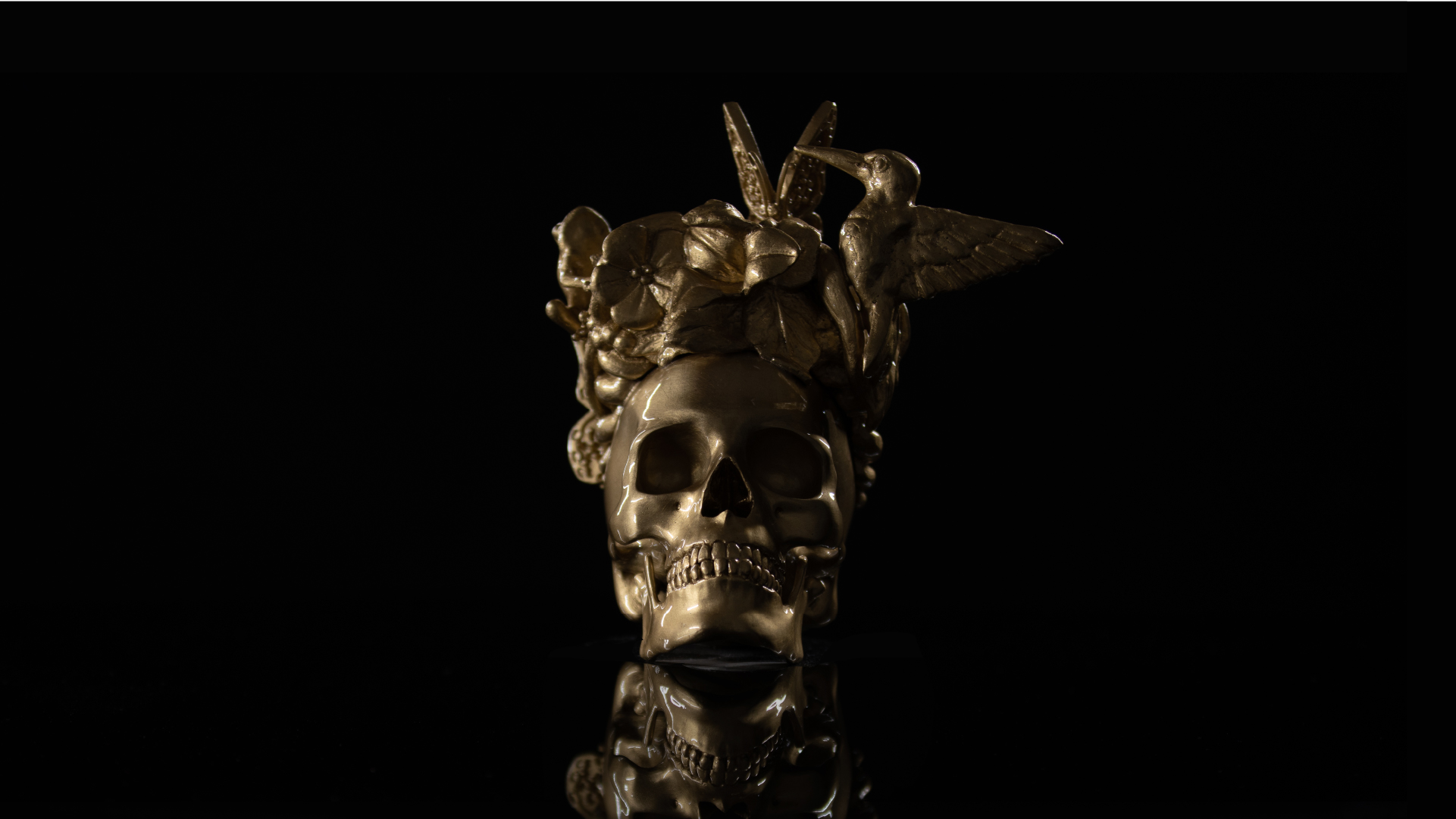
The first piece in the series is the Tehuana. A bronze skull with a headdress built from elements of the Nahuatl cosmovision: butterfly (pāpalōtl), flower (xōchitl), hummingbird (huitzilin), and frog (cueyatl).
None of those elements is decorative. Each carries meaning within the Nahuatl philosophical system — duality, transformation, transition between worlds, fertility, memory.
The Tehuana does not represent a dead woman. It represents the continuity of the feminine through time.
Why bronze — and why now
The choice of bronze is not coincidental. It is the material of civilizations that wanted to be remembered. Lost wax casting — a process over five thousand years old — ensures that each piece is unique and unrepeatable: the mold is destroyed to reveal the sculpture.
Each piece in the Calavera Mexicana series takes between six and twelve months to produce. From the model in plasticera, through digital tools such as 3D modeling, 3D printing, and laser cutting, to the final casting at the foundry of master craftsman Juan Hernández — who has worked with artists including Yvonne Domenge and Jan Hendrix.
This is not production. It is materialized research.
Eight years, six sculptures, one book
The Calavera Mexicana project was not born from trend or intuition alone. It was built over eight years of historical investigation — research into the meaning of the skull in pre-Hispanic art, colonial art, and contemporary Mexican culture.
That investigation became the book Arroyo, Calavera Mexicana — a bilingual, limited edition volume that won first place in the art book category. Six sculptures. One book. One registered trademark. Built entirely through self-management.
Not because the skull is fashionable. Because it is one of the most powerful cultural symbols Mexico has ever produced — and almost no one is treating it with the depth it deserves.
Watch the full video
This article is the written companion to the first video on the Calavera Mexicana YouTube channel. Watch it here:
→ Discover the book Arroyo, Calavera Mexicana at perlaarroyo.com
BOLETÍN
* Llenado obligatorio para continuar
Al suscribir aceptas los términos, políticas y condiciones de este sitio web.
Podrás cancelar tu suscripción a través del correo que recibas de nuestra parte en el momento que desees.
