
Coatlicue: The Mother Goddess of the Mexica Pantheon — and Why She Was Buried Again and Again
24 de July de 2026
In August 1790, workers carrying out routine paving work in the Plaza Mayor of Mexico City, ordered by viceroy the Count of Revillagigedo, uncovered a stone sculpture 1.5 meters below the surface. The details of that day survive thanks to the notes of an indirect witness: a halberdier guard of the viceregal palace named José Gómez, who kept a diary. It was understood to be so powerful — so foreign to any category the Western gaze could handle — that the authorities ordered it buried again.
The discovery unsettled the Indigenous population, and the New Spanish authorities read it as an ill omen, so they decided to bury it beneath the cloister of the Royal and Pontifical University — that is, the sculpture was first moved to the University’s courtyard for study, and it was there that the authorities (university and ecclesiastical, alarmed by the fear that it would revive pre-Hispanic devotion) ordered it covered.
Coatlicue was not forgotten — she was silenced, again and again. First by the Mexica themselves, who buried her after the fall of Tenochtitlan to save her from destruction, and she remained underground for nearly 270 years. In 1790, the astronomer and antiquarian Antonio de León y Gama studied her and published the first scientific description of the piece — the founding document of Mexican archaeology: the Descripción histórica y cronológica de las dos piedras, on Coatlicue and the Aztec calendar, published in 1792. But before that study could take hold, the sculpture had already been buried again in the University’s courtyard, out of fear that her cult would revive: university students and informed members of the public had begun visiting her in droves, the way one visits the Virgin of Guadalupe. And that seemed dangerous. She was briefly unearthed again in 1803, so that the German explorer Alexander von Humboldt could study and draw her — and reburied as soon as he finished. In 1823 she was exhumed once more, this time so that an English businessman could make a mold to be exhibited in London. It was not until 1825, with the founding of the Museo Nacional, that she finally remained on view.
What the Western Reading Cannot See
When viceregal-era scholars first described the Coatlicue statue, they used one word: monster. And from within their system of thought, they were right. A figure with no human head — replaced by two facing serpents. A necklace of hands and hearts. A skirt of interwoven serpents. Claws in place of feet.
From a Western Christian logic, that is a figure of terror. From a Nahua logic, it is the most precise existing representation of how the cosmos works.
The difference is not aesthetic. It is philosophical.
In the Nahua worldview, Coatlicue is Tēteoh Innān, the mother of the gods, the point where the entire system converges: present, past, and future.
Beneath her body, carved into the same stone, is the representation of Tláloc-Tlaltecuhtli, symbol of the agricultural cycle. In Nahua philosophy, the gods did not divide their roles by gender or sex, but by complementarity; they were generally represented in pairs, with reciprocity among the different forces of the cosmos, divided essentially among the four cardinal points and the four elements of life, and transversally along the axis of birth-life-death, sky-earth-underworld — not as opposites, but as a single, eternal cycle of life. They are parts of the same cycle and the same force.
The imposing anthropomorphic body is crowned by two serpents that replace the head, which was severed; in this way, the two serpent heads do not merely replace a lost face — they turn the goddess into the axis of time itself. The necklace of hands and hearts may be the record of a principle: that life is sustained by life, that there is a permanent exchange between what is received and what is given back. The skirt of serpents is a vehicle of vital force, fertility, and transformation. This sculpture is the representation of the most sophisticated philosophy of balance known in the Nahua world.
Coatlicue and Nefertiti: Two Civilizations, the Same Question
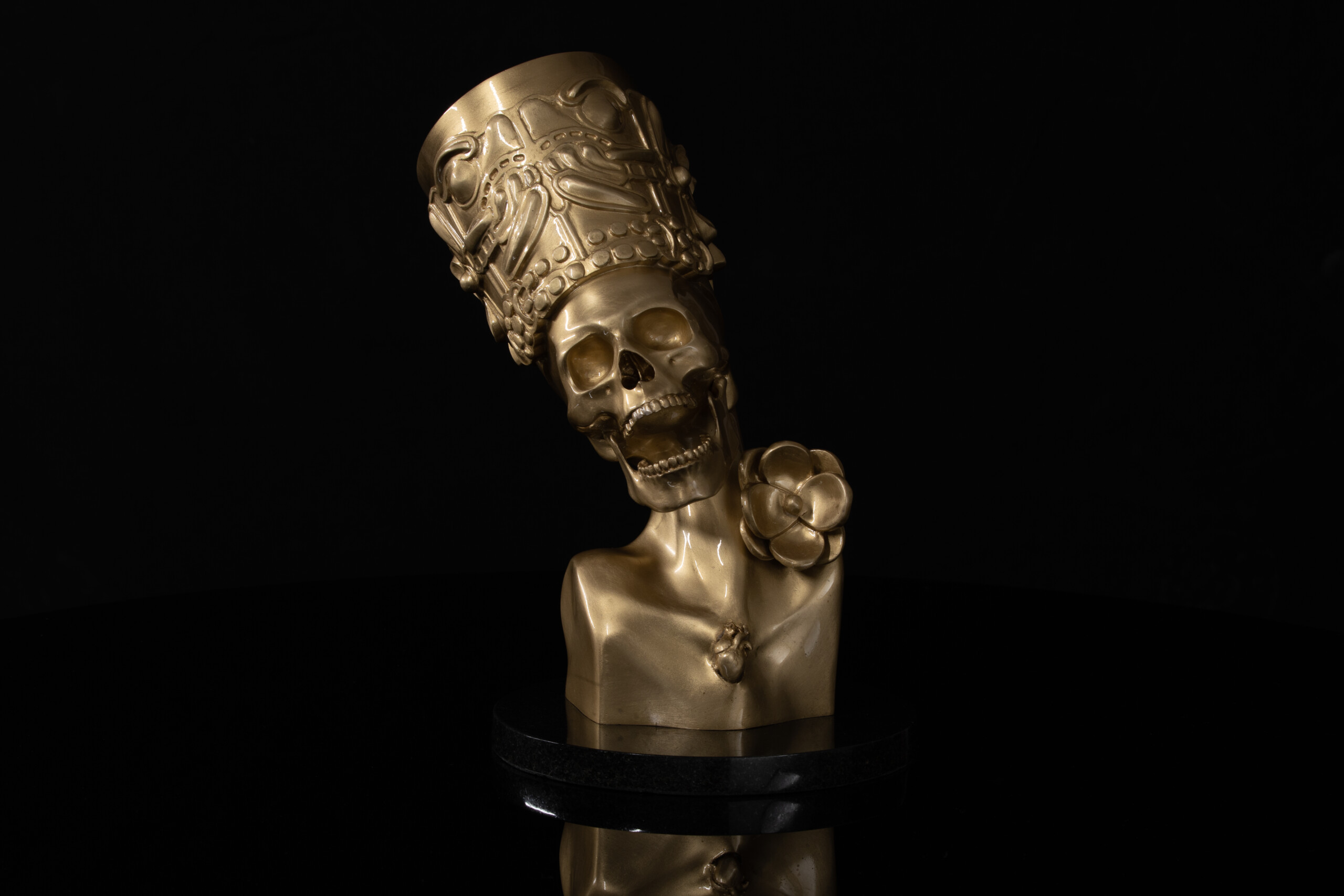
When I worked on this piece for the Calavera Mexicana series, the question guiding me was not historical but philosophical: how do I materialize in bronze a force that contains everything?
The answer came from placing Coatlicue in dialogue with Nefertiti. Not because they are equivalent — they are figures of entirely different natures. Coatlicue is the cosmic generative force of the Mexica pantheon. Nefertiti was a real queen, consort of Akhenaten, a figure of political and religious power in fourteenth-century BCE Egypt. She was not a goddess. She was a woman with absolute power in a civilization that organized the cosmos around her.
But the two civilizations — Egypt and Mexico — built something in common: the image of the feminine as the origin and sustainer of all that exists. Two cultures that never met, separated by thousands of kilometers and centuries, arrived at the same fundamental question: what does it mean to contain life and death simultaneously?
That is why the sculpture wears Nefertiti’s crown over Coatlicue’s serpent heads. Two civilizations that singled out the female head as the symbol of the most powerful forces governing their cultures: political power, royal status, and divine authority. Two distinct civilizations, in distinct eras, both providers of divine, royal, and cosmic order.
The Symbols That Compose Her
On the piece’s shoulder: the wild dahlia. Mexico’s national flower, known in the fifteenth century as “cup of water” or “water cane.” A flower of Mexican soil — nature as a symbol of what generates and sustains.
At the center of her chest: the teyolía. The heart that carries the soul in Mexica cosmogony — one of the three principal animating entities. The seat of life, of mental faculties, and of the person themselves. The teyolía does not die with the body. It travels. It endures. It transforms.
Death crowned with the pharaonic force of the feminine as force — not as the opposite of the masculine, but as a single entity, one that together, as layers, sounds in symphony two dissimilar myths within a single composition: Coatlicue-Nefertiti.
What Was Lost When She Was Buried
I want to return to the fact I opened with. In 1790, she was buried because she could not be understood. There was no room in their categories for a figure that held life and death at the same time, without one defeating the other.
What was buried along with Coatlicue was a way of understanding the world in which duality is not a problem — it is the condition of everything that exists. A philosophy of balance that never needed to resolve the tension between opposites, because it never considered them opposites to begin with.
That philosophy was suppressed because it was incompatible with the system that buried it — a system that needed death to be punishment and life to be merit, needed opposites to be irreconcilable, needed there to be a winner and a loser.
The consequence is not merely archaeological. It is cultural, psychological, collective. A culture that understands fragmentation as cycle — like Coatlicue, like the moon that dismembers and returns — seeks tools to process what hurts it that no other tradition can offer.
Burying that is part of the emptiness that runs through our identity.
Why Bronze — and Why Now
The choice of bronze is not incidental. It is the material of civilizations that wanted to be remembered. The lost-wax casting technique — a process more than five thousand years old — guarantees that each piece is unique and unrepeatable: the mold is destroyed to reveal the sculpture.
The Coatlicue-Nefertiti piece from the Calavera Mexicana series took approximately five months to produce. The original model combined 3D modeling, 2D design, and traditional sculpting. The crown was traced by hand on paper. The body was built in wire and modeling clay. The flower, in wire and modeling paste. The heart, in 3D modeling. Each piece was assembled separately and then cast in bronze, at master Juan Hernández’s workshop.
This is not production. It is research materialized in bronze.
Coatlicue is not a monster. She is the origin of everything. And that difference changes everything.
→ Discover the Coatlicue-Nefertiti piece at perlaarroyo.com · Available on Saatchi Art
Perla Arroyo is a contemporary Mexican sculptor, researcher, and author. Creator of Calavera Mexicana®, a series of six bronze sculptures and a bilingual artist’s book awarded 1st place at the Gran Premio de Artes Gráficas 2025. Exhibited at the Museo de la Cancillería, MNA, MUAC, UAM, FIL Guadalajara, Madrid, and soon in Phoenix, Arizona. · perlaarroyo.com
Coatlicue · Nefertiti. Lost wax bronze casting. 35 x 22 x 31 cm · 5 kg · Limited edition of 8. Perla Arroyo, 2024. Calavera Mexicana® series.
BOLETÍN
* Llenado obligatorio para continuar
Al suscribir aceptas los términos, políticas y condiciones de este sitio web.
Podrás cancelar tu suscripción a través del correo que recibas de nuestra parte en el momento que desees.
