
Coyolxauhqui: The Dismembered Moon Goddess Who Never Stopped Shining
20 de June de 2026
On February 21, 1978, workers from the Mexico City electric company were excavating beneath Guatemala Street in the historic center of the city. Two meters down, their pickaxes hit something. It was not rock. It was sculpture.
What they found was a stone disk, 3.25 meters in diameter, depicting the dismembered body of a woman. Archaeologists identified her immediately: Coyolxauhqui — the moon goddess of Aztec mythology. She had been buried since the 15th century, beneath the streets of the city built on top of Tenochtitlán. The discovery triggered one of the most significant archaeological excavations in Mexican history and led to the creation of the Museo del Templo Mayor.
But before we talk about what they found, we need to talk about who she was — and why her story changes how we understand the Mexican skull.
Who is Coyolxauhqui?
Coyolxauhqui — whose name means “she who is adorned with bells” — is the moon goddess in Nahuatl cosmovision. Daughter of Coatlicue, the earth goddess, and sister of Huitzilopochtli, the sun god, she occupies one of the most complex roles in Aztec mythology.
According to the myth, when Coatlicue became pregnant with Huitzilopochtli — through a ball of feathers that fell from the sky — Coyolxauhqui led her four hundred brothers to kill their mother in anger. But at the moment of the attack, Huitzilopochtli was born fully armed, and in a single act he defeated his siblings and dismembered Coyolxauhqui. Her body fell from the hill of Coatepec, fragmenting as it descended.
In Western mythology, that would be the end of the story. The villain is defeated. The hero triumphs. But in Nahuatl cosmovision, the story does not end there — because in Nahuatl thought, nothing truly ends.
Fragmentation is not defeat — it is transformation
Coyolxauhqui governs the night sky, the cycles of the moon, and the rhythms of time itself. Her dismembered body, scattered across the cosmos, became the source of her power — not the evidence of her defeat. Every night, the moon rises. Every month, it completes its cycle. Every year, it governs the tides, the agricultural calendar, the ceremonies.
In Nahuatl cosmovision, duality is not contradiction — it is the fundamental structure of reality. Life and death, light and darkness, creation and destruction are not opposites. They are phases of the same continuous process. Coyolxauhqui embodies that duality with absolute clarity: she is defeated and she endures. She is dismembered and she persists. She is buried for five hundred years and she is found.
She was broken. She was buried. And she endured.
The Coyolxauhqui Stone and the birth of Mexican archaeology
The stone disk discovered in 1978 is now one of the most important pre-Hispanic sculptures in existence. It measures 3.25 meters in diameter and weighs approximately 8 tons. The figure of Coyolxauhqui is depicted dismembered — her head, arms, and legs separated from her torso — but arranged with extraordinary compositional harmony within the circular form.
The discovery led to the excavation of the Templo Mayor — the great pyramid at the center of Tenochtitlán, which had been buried beneath colonial construction for centuries. Today, the Coyolxauhqui Stone is displayed at the base of the Templo Mayor replica in the Museo del Templo Mayor in Mexico City — in the exact position it was found, at the foot of the pyramid where her myth placed her.
Coyolxauhqui in the Calavera Mexicana series
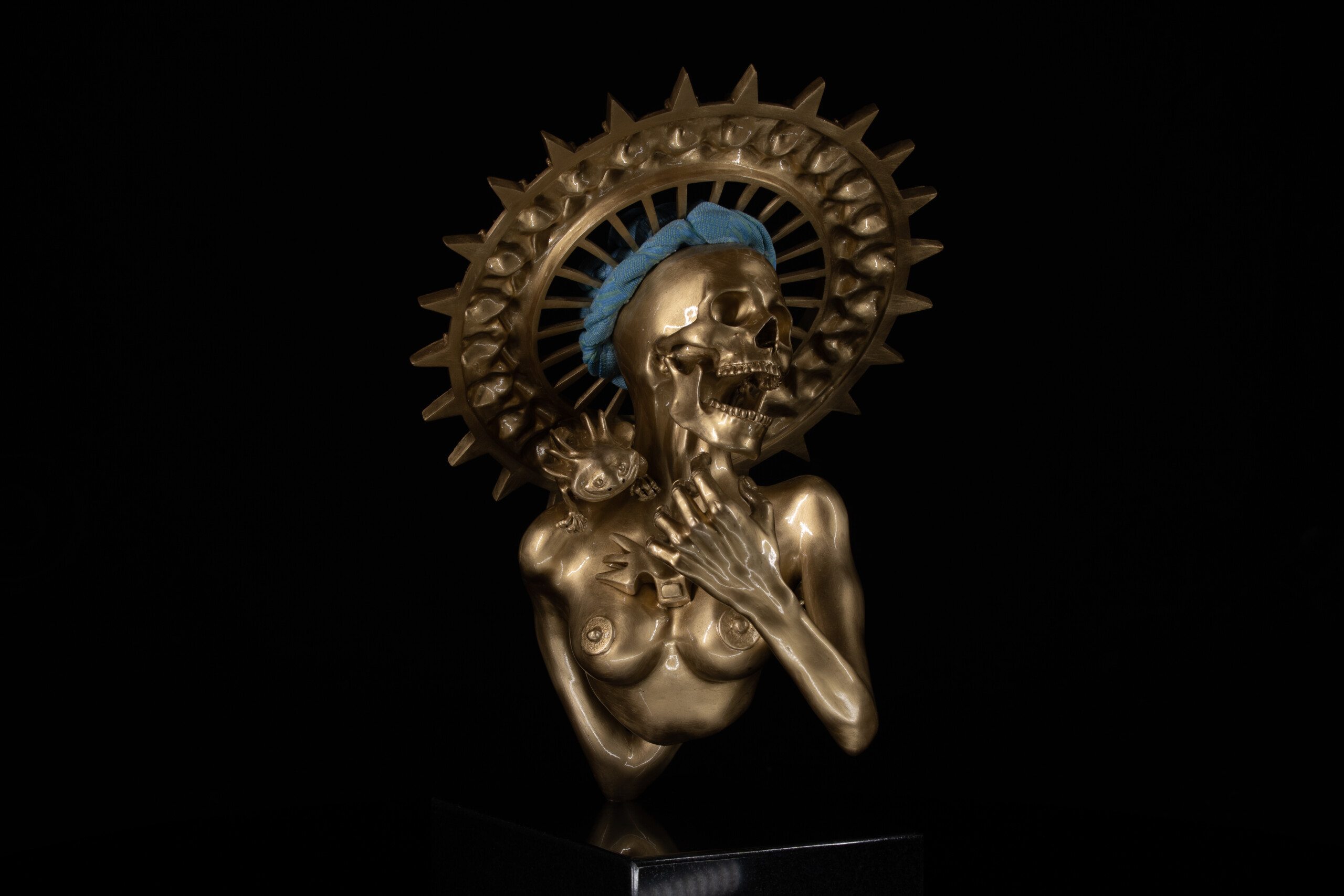
The Coyolxauhqui sculpture in the Calavera Mexicana series by artist and researcher Perla Arroyo does not depict defeat. It depicts continuity.
The piece is cast in bronze through the lost wax casting technique — a process over five thousand years old, in which the mold is destroyed to reveal the sculpture, making each piece unique and unrepeatable. The figure carries three symbols drawn directly from Nahuatl cosmovision: the butterfly (pāpalōtl), symbol of transformation; the axolotl, symbol of regeneration; and the solar disk of her headdress, symbol of the cosmic cycles she governs.
None of those elements is decorative. Each one is a philosophical argument materialized in bronze.
The Tehuana does not represent a dead woman. The Coyolxauhqui does not represent a defeated goddess. These sculptures represent what the Mexican skull has always represented in Nahuatl thought: the continuity of what matters most — memory, identity, and the unbreakable thread between those who came before and those who come after.
Eight years of research materialized in bronze
The Calavera Mexicana series — six bronze sculptures created over eight years of historical and aesthetic research — exists because of one question: why has the Mexican skull been reduced to decoration?
It carries five thousand years of meaning. The Nahuatl philosophical system that produced Coyolxauhqui, Coatlicue, the Xoloitzcuintle, and Sor Juana Inés de la Cruz is one of the most sophisticated frameworks for understanding existence ever developed by any civilization. The skull — tzontecomatl in Nahuatl — is not a symbol of death. It is a vessel of what is most valuable: the mind, memory, and identity of a person.
That is what Calavera Mexicana is about. Not death. Continuity.
Follow the full story
The full story of Coyolxauhqui is coming soon to the Calavera Mexicana YouTube channel — history, philosophy, and the process behind the bronze sculpture, documented in depth.
→ Subscribe now: youtube.com/@calaveramexicana
→ Discover the complete series: perlaarroyo.com
BOLETÍN
* Llenado obligatorio para continuar
Al suscribir aceptas los términos, políticas y condiciones de este sitio web.
Podrás cancelar tu suscripción a través del correo que recibas de nuestra parte en el momento que desees.
