

Mexican Skull by Perla Arroyo. Seductive Emblem.
7 de March de 2022
Death is democratic, since, at the end of the day, whether black, brown, rich or poor, all people end up being skulls.
José Guadalupe Posada.
Text by: Luis Ignacio Sáinz
Perla Arroyo invites us to her Mexican Skull without adjectives, renounces the grandiloquence of its appearance to anchor in its original meaning and mystery. To rescue its objectual quality, sensitive but reflexive, and above all aesthetic. It transcends the banality that has made the skull a puerile symbol, devoid of full content. In the case of this creator, it is about showing and enhancing an emblem or icon (εικόνισμ, image): sum of figure and concept, which performs as a sign (union of signifier and signified).
Calavera is a masculine noun from the Latin calvarĭa, meaning skull. In addition, calvarium (place of skulls) designates a deposit of bones, ossuary, or place of penalties — a miscellany of articulated, flayed head bones. And yet its force is preponderantly feminine.
Arroyo distrusts appearances; she insists on searching for the underlying structures. She disdains epithelial beauty — that shell which, by containing and covering us, also deceives and stuns us, offering a frivolous vision of our animated being. Against the current, in order to encounter primordial solidity, her ability to designate, invent, and analyze the environment and its components leads her to identify the bone tissue that contains our most precious jewel — the brain — and to crown it with a headdress composed of a miscellany of species: butterfly (pāpalōtl), flower (xōchitl), frog (cueyatl), and hummingbird (huitzilin). Dual elements of life-death and gender, nexus of the sacred and the profane, transit from the earthly to the cosmic and back — fulfilling the complete journey of the Mesoamerican weltanschauung (which I understand more as “intuition of the world” than as “cosmovision”): the continuity without rupture of poles that are never opposites, but phases of the process of being and its manifestations, involving different layers of meaning: intellectual, emotional, and moral (Wilhelm Dilthey: Einleitung in die Geisteswissenschaften, 1914).
Such a parade of life prowls through the bald head, plundered of its layers and integuments that usually protect it and endow it with a unique personality. Synonyms of harmony and beauty that equally resonate with the goodness attributed by indigenous cosmogony to this metaphor of life beyond life (tzontecomatl, skull; cuaitl, head), and its course through the pilgrimage in the underworld (Mictlán). Arroyo’s skull keeps a certain hieratism — something sacred and immobile that summons us to unravel its enigmas and secrets.
However, its representation keeps a certain distance from the “skeletal” popularity we owe to Manuel Manilla (Calavera tapatía; broadsheet from the workshop of Antonio Vanegas Arroyo; 1890), and which José Guadalupe Posada would exalt to the point of delirium (Remate de calaveras alegres; broadsheet from the workshop of Antonio Vanegas Arroyo; 1913).
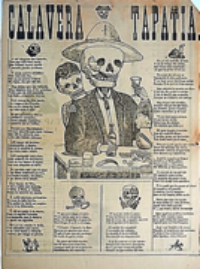
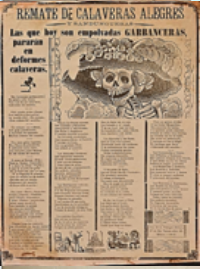
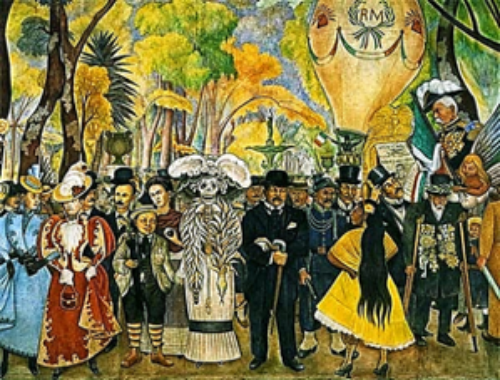
Although its universal fame is due to Diego Rivera — who definitively baptized it as La Catrina and placed it at the center of A Dream of a Sunday Afternoon in Alameda Park (1947), a mural in which the artist from Guanajuato collaborated with Rina Lazo — where “la huesuda” appears for the first time in full body, dressed, covered with a feather stole and flanked by the artist as a child, embraced by Frida Kahlo, and the engraver from Aguascalientes. A letter of naturalization for the good death, accompanied in this social debut by more than one hundred figures from national history in an eccentric hodgepodge: among them, positioned toward the extremes, Benito Juárez and Porfirio Díaz, while Sor Juana Inés de la Cruz, the Emperor Maximilian, the apostle of democracy Francisco I. Madero, and Hernán Cortés pose gravely — alongside the embrace of Manuel Gutiérrez Nájera and José Martí.
Thus, Perla Arroyo’s three-dimensional representation draws on other transatlantic sources: the subgenre of the Vanĭtas (from the Latin vanus: empty), belonging to the geography of still life — a sobering reminder of the ephemerality of power, wealth, and beauty, very visible in Baroque art, emerging in Flanders and the northern provinces (present-day Holland) before settling throughout Europe in its own right. A designation originally rooted in Ecclesiastes (1:2): Vanitas vanitatum et omnia vanitas — “Vanity of vanities, all is vanity.” A Senecan sentence that underlines the insignificance and futility of existence. Further on in the same biblical text (9:10): “…for in the grave, where you go, there is neither work, nor device, nor knowledge, nor wisdom.
Without fanfare, Mexican Skull manifests an air of seriousness and transcendence. It does not intend to be playful or circumstantial, but rather an announcement of an intangible, philosophical, spiritual vitalism in the broad sense — alluding to the immaterial dimension, endowed with intelligence and reason, sensitive and meditative, far from the temptations of the world, the flesh, and the devil. Calavera Mexicana acts as a guide on a journey into the depths, beyond the obvious, anchoring in the bedrock of our most settled and nourishing convictions.
Life-death: appearances are deceptive, nothing more than shells. The gratifying surface pleasures that lead the soul astray and confuse the spirit are the enemies to be defeated in the moralizing lessons of a plastic genre — the vanitas — linked to the Baroque as a counterweight to its theatricality and excess, stigma of a vertigo that annuls reflection. Faced with the dominant sensuality that finds its champion in concupiscence, the warnings of the ephemeral — those announcements of ruin and decay — reach a not inconsiderable dose of macabre obscenity: the gratification of pain and the narcissism of putrefaction.
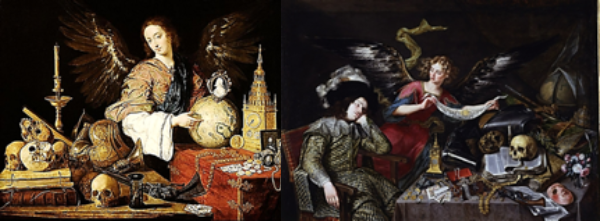
Alegoría de la Vanidad (1632-1636) – Sueño del caballero (1650).
Perla Arroyo affirms her Mexicanness in the recognition of contributions from other latitudes. Her desire to know is complemented and enriched by the perspectives of those others who are interlocutors and not adversaries. The sustained character — the integral nature — of Nahuatl thought constitutes the backbone of her visual reflections, making her a worthy heir to the ancient tlamatinime, those wise ones from afar who “knew things,” and tlacuiloque, those who wrote while painting — or in this case, sculpting and modeling in 3D. Hers is a contemporary gaze, a kind of syncretism that emphasizes, I insist, dynamic continuity, because change is an immanent value to this philosophy, where accidents and chance are valued and incorporated into the flow of represented reality, as image, as reflection. This is the meaningful universe of Calavera Mexicana.
BOLETÍN
* Llenado obligatorio para continuar
Al suscribir aceptas los términos, políticas y condiciones de este sitio web.
Podrás cancelar tu suscripción a través del correo que recibas de nuestra parte en el momento que desees.
